The Geography of Yearning: Nicole Cohen’s Haute History Lesson
If you type the word “home” into a search engine, you will instantly confront billions of digital echoes. It is an amorphous, ever-evolving idea—once lit by firelight, now by the cool glow of a pixel, miraculously liberated from the material encumbrance of bodies, spaces, and stuff. Yet, it is precisely the material “stuff” of domesticity that holds our deepest fantasies. We see it in the frantic, exquisite choreography of preparing our houses for weekend guests—arranging the furniture, dressing the bedding, composing an ideal tableau of welcome like a living picture. It’s the same distinct, voyeuristic pleasure that draws us to the glossy pages of shelter magazines, the pristine curation of museum period rooms, and the ultimate playground of historical “dress-up”
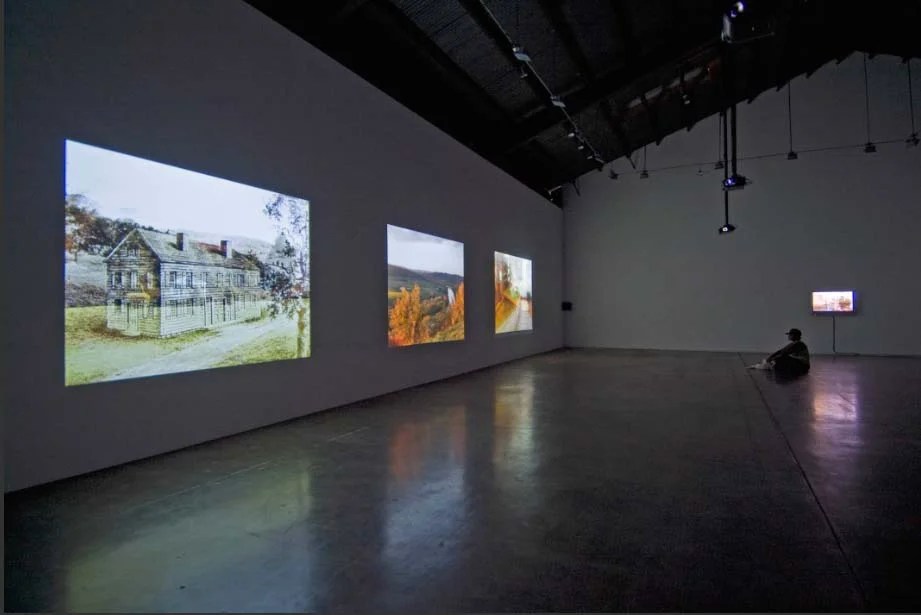
In French Connection, an evocative exhibition of video installations and drawings, artist Nicole Cohen masterfully taps into this exact psychology of style, space, and spectacular misconnection.
[ THE BINARY OF FRENCH CONNECTION ]
│
┌───────────────────────┴───────────────────────┐
▼ ▼
THE VIDEO SUITE THE SKETCHBOOK
• Soundscapes: Frontier vs. Fine Art • Medium: Pencil & pastel on thick paper
• Aesthetic: Marie Antoinette’s missed flight • Aesthetic: Louis XV meets wilderness survival
The Ultimate Royal Fantasy
The couture-grade concept behind French Connection sprouted from Cohen’s high-profile commission by the J. Paul Getty Center, where she subverted French decorative arts into interactive, Kubrick-esque video installations. But here, the narrative shifts from the museum archives to a fascinating, forgotten footnote of history: French Azilum.
Conceived on a secluded bend of Pennsylvania’s Susquehanna River, this frontier colony was plotted by wealthy refugees fleeing the terrors of Europe and Haiti. Their grand, impossible design? To build an architectural asylum for Queen Marie Antoinette, assuming a miraculous escape from the guillotine. The exiles spared no effort to recreate their lost habitat, erecting French bistros, boutiques, and formal landscaping to soothe their displaced aristocratic soul
The Queen, of course, never arrived. What remains is a ghost town of the imagination—a monument to a homemaker’s eternal, anxious waiting.
The Chronicle of a Failed Eden: A Timeline of French Azilum
To fully appreciate Cohen’s investigation into the psychology of this space, one must understand the brief, dramatic lifeline of the settlement itself:
[1790s: THE FOUNDING] ──► [THE GRAND MAISON] ──► [THE 10-YEAR MARK] ──► [THE MIGRATION]
Refugees arrive from Built with 8 chimneys The colony collapses Exiles move south to Europe & Haiti (Santo for a Queen who never after a decade of their new “French
Domingo). arrived[cite: 1, 2, 3]. hardship. Riviera”.
-
The 1790s (The Arrival): French refugees fleeing the French Revolution in Europe and violent uprisings in the island colony of Haiti (then Santo Domingo) converge on a seemingly blank slate of thousands of acres along the Susquehanna River. Treating the North American continent as an Edenic reserve free of human history, they lay out half-acre plots to build a utopian frontier township.
-
The Royal Plan: Amid the construction of a new urban infrastructure, the settlement is designated as a refuge for the deposed Marie Antoinette. A massive, prominent residence known as the Grand Maison is erected, boasting eight chimneys and designed to host the Queen and her aristocratic court in fitting luxury[cite: 2, 3].
-
The Collapse: The fantasy is cut short by a grim reality—the Queen is executed, never setting foot in Pennsylvania. The entire enterprise ultimately survives for only ten years.
-
The Migration: Unable to bear the isolation and the brutal conditions of the extreme northern cold, the wealthy French exiles abandon their shops and bistros. They relocate down south, migrating to the Carolinas and eventually New Orleans, establishing a more hospitable “French Riviera”.
-
The Modern Site: Today, not a single original structure from the 1790s settlement remains standing. The historic plot exists only as a foundation, a few reconstructed outbuildings, and a small museum housing period artifacts.
A Runway of Textures: The Exhibition
Cohen explores this historic culture-clash through an intentional formal pairing, contrasting European refinement with the abrasive realities of the American wilderness.
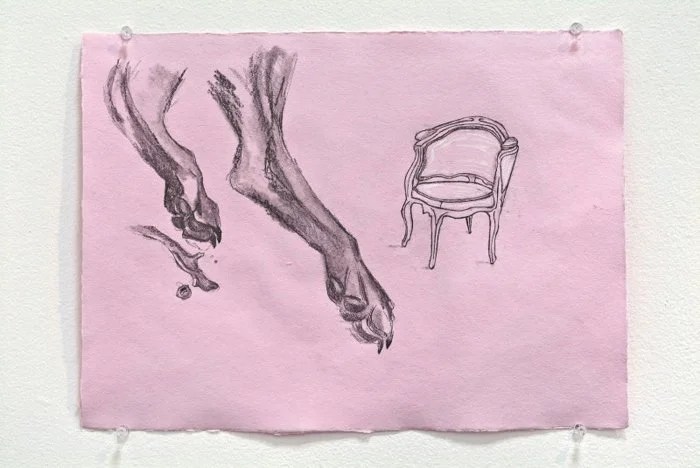
In a suite of sixteen pencil and pastel drawings, executed on thick paper in delicate shades of pink, blue, and fawn—colors that evoke the ultra-feminine, leisurely palette of a court lady’s wardrobe—the artist stages a series of surreal sartorial confrontations. With book-illustration precision, a Louis XV drawing room settee is juxtaposed with a spitted deer; a rococo corner chair sits beside the disembodied legs of a wolf. It is the ultimate pastoral “dress-up” fantasy. One can’t help but imagine the Queen, who famously loved playing the simple milkmaid at her Petit Trianon farm folly in Versailles, entirely unprepared for the crude frankness of actual frontier survival.
The exhibition’s four video loops are presented as a cinematic experience, set in a darkened space suffused with a melancholic, mash-up soundtrack: the raw folk guitar of John Fahey’s Poor Boy a Long Ways from Home interlaced with the mournful, European sophistication of Beethoven’s Pathetique sonata.
-
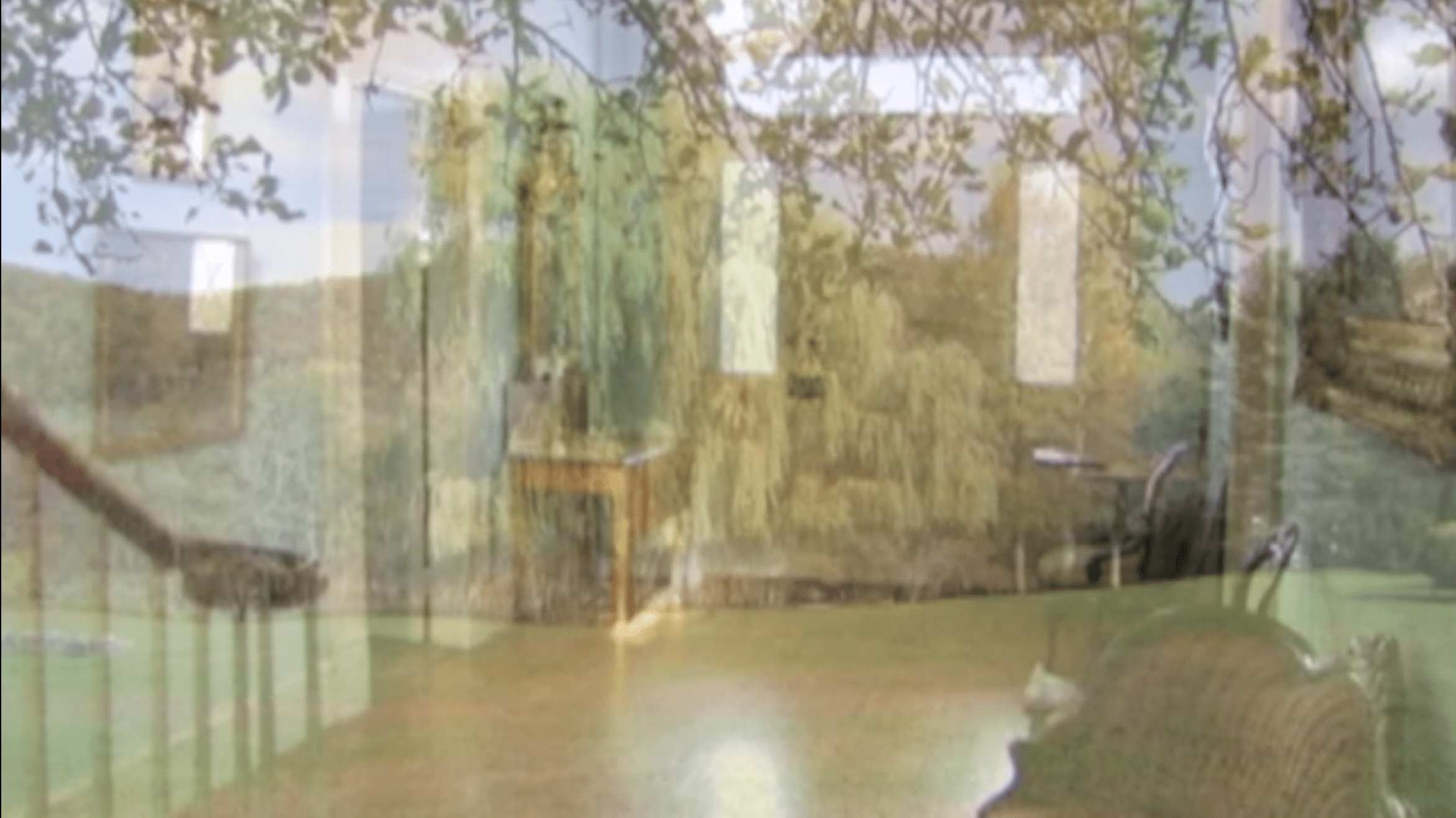
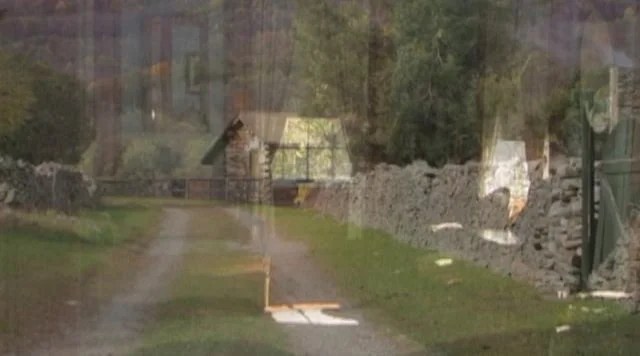
Marie Antoinette’s Lookout: Captures a classically flawless, golden-ratio landscape of rolling hills. As the autumn foliage stirs, the digital image is slowly obscured by a historic archive drawing of the exact same view, highlighting the unrecoverable gap between past and present[cite: 2, 3]. Cohen actually drove through Pennsylvania during the height of autumn, matching her camera angles to sketches made by the original 18th-century settlers.
-
Driving: Pairs sleek, leisurely interior shots of Versailles and neoclassical rooms with a high-speed, anxious tracking shot down a long country road. The peaceful pleasure of interior design inspection is instantly charged with the adrenaline of flight and the pursuit of a safe arrival that never comes.
Home is Where the Art Is
For Nicole Cohen, who was living in Berlin and adapting to a new culture while creating this body of work, the project became deeply personal. “For me, the concept of home has been an ongoing anchor in my work: a place to rest, reboot, express your style, self-reflect, and contemplate,” she notes.
Cohen works with images of historical places and creates performances that overlay onto the static photo frozen in time to the ever-changing reality of today, using people selected from the street to show what time we are living in today. The juxtaposition of the past and photo give us a better understanding of identity of how place and time, can reveal our progress. Whether this “progress” is about the development of mankind and how we live and grow, shaping new realities through time.
Navigating her own displacement allowed her to realize that the old cliché—home is where the heart is—is actually far more profound and far less trite than she ever wanted to admit[cite: 3]. French Connection is an exquisite reminder that no matter how far we travel, we always carry our constructed perceptions, our cultural objects, and our favorite style scripts with us to invent a new home in the wilderness.
Art Review X-TRA Magazine by Ellen Birrell:http://x-traonline.org/article/nicole-cohen-french-connection/. Exhibition at Shoshana Wayne Gallery, Los Angeles